



The world of gaming has never stood still — and in 2025, it’s moving faster than ever. What was once pixel art and wired controllers has evolved into an immersive digital universe powered by artificial intelligence, ultra-realistic graphics, and cloud-based innovation. Gaming today is not just entertainment — it’s technology’s most exciting frontier.
From hyper-responsive consoles to metaverse ecosystems and mind-bending AI companions, the fusion of creativity and engineering is reshaping how we play, compete, and connect. The next generation of gaming is here — and it’s rewriting the rules of reality.
Power Beyond the Console
The console wars are no longer just about performance; they’re about ecosystem power. Sony, Microsoft, and Nintendo have transformed their hardware into complete digital worlds. The PlayStation 6 and Xbox Nexus now run on cloud-integrated architectures, letting players switch seamlessly between devices — from TV to tablet to VR headset — without missing a frame.
The age of heavy downloads is fading fast. Cloud services like Xbox Cloud Gaming, PlayStation Plus Premium, and NVIDIA GeForce NOW are delivering 4K, high-fidelity experiences through lightning-fast networks. The result? Console-quality games, no console required.

But this evolution isn’t just about access — it’s about freedom. Players can start a game on their smartphone during a commute and continue it at home on a full-size display with the same progress, settings, and AI-driven adjustments. Gaming has become truly borderless.
AI: The Game-Changer Behind the Scenes
Artificial intelligence has revolutionized gaming far beyond smart NPCs. Today, AI is the creative engine behind procedural worlds, adaptive storytelling, and personalized difficulty levels.
Imagine entering a role-playing game where every character reacts uniquely to your actions — not pre-programmed, but dynamically learned through AI. Games like Starfield Odyssey and Eclipse Horizon already feature evolving narratives powered by machine learning, ensuring no two players ever share the same story.
AI also plays a crucial role in game design. Developers use generative models to create vast landscapes, realistic lighting, and even emotional soundtracks in a fraction of the time. It’s not replacing human creativity — it’s amplifying it.
The Rise of Immersive Realities
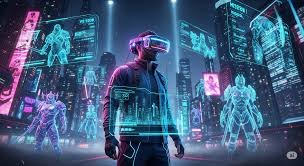
Virtual and augmented reality have entered their golden age. Devices like Apple Vision Pro, Meta Quest 4, and Sony’s PSVR 3 are turning living rooms into portals to other worlds.
Today’s VR experiences are no longer isolated simulations — they’re social ecosystems. Gamers can explore galaxies, solve mysteries, or attend concerts alongside real friends, all within shared digital spaces. Motion tracking, haptic feedback suits, and eye-sensing technology add realism that blurs the boundary between the physical and virtual.
Augmented reality (AR) is also taking hold. AR-enabled games like Pokémon WorldSync and HoloRaiders project lifelike creatures and quests into real environments using advanced spatial computing. The next evolution? Full mixed reality, where both worlds coexist seamlessly.
E-Sports and the Global Arena
The competitive gaming industry has transformed into a multi-billion-dollar powerhouse. With immersive broadcasts, AI-enhanced analytics, and interactive fan engagement, e-sports has become the digital era’s version of global sporting leagues.
Teams train in smart studios equipped with biometric sensors that track reaction time, focus, and stress levels. AI coaches provide real-time strategy adjustments, while fans tune in through 360° live streams and virtual arenas that let them “stand” right behind their favorite players.
Games like Valorant, Fortnite, and League of Legends continue to dominate, but new contenders built around blockchain rewards and skill-based economies are changing the way success — and ownership — are defined in gaming.
Gaming Meets the Metaverse
The metaverse isn’t just a buzzword anymore — it’s becoming a fully realized digital civilization. Gaming platforms are at its core. Epic Games’ Unreal Engine 5.5 and Unity’s latest tools allow developers to create persistent worlds where players can live, trade, create, and compete.
These spaces are powered by blockchain for digital ownership, allowing players to buy, sell, and even design virtual assets that hold real-world value. Virtual fashion, real estate, and branded experiences are merging with traditional gameplay, transforming games into lifestyle ecosystems.
The line between player and creator is fading fast — in the metaverse, everyone can build their own world.
Sustainability and the Future of Play
As gaming technology evolves, so does its environmental responsibility. Companies are investing in energy-efficient servers, recyclable materials, and carbon-neutral production. Cloud gaming reduces the need for physical consoles and discs, while AI optimization lowers energy usage during gameplay.
Sustainability has become part of gaming’s narrative — proving that the future of entertainment can be innovative and responsible.
The Next Level: Gaming as a Way of Life
Gaming in 2025 is no longer confined to screens — it’s woven into the fabric of daily life. It fuels creativity, builds communities, and pushes technology forward in ways few industries can match.
Whether you’re exploring distant galaxies through VR, battling in e-sports arenas, or designing your digital avatar in the metaverse, gaming is now a shared human experience — one that celebrates imagination, innovation, and play.
The next era of gaming isn’t just about better graphics or faster processors. It’s about possibility — a limitless playground where technology and humanity evolve together.
